

Fire-rated windows are one of the most misunderstood systems in commercial and high-end residential construction.
They look like standard glazing systems.
They install like standard glazing systems.
But under extreme heat, they behave very differently.
Let’s break down exactly how fire-rated windows work, what 45–90 minute ratings mean, how they’re tested, and why steel is the clear leader when fire protection matters.
What Is a Fire-Rated Window?
A fire-rated window assembly is a tested and certified system designed to confine fire and prevent it from spreading from one area of a building to another for a specified time period.
It is not just glass.
It is not just a frame.
It is a complete tested assembly.
Definition of Fire-Resistance Rating
A fire-resistance rating indicates the amount of time a window maintains its integrity during a standardized fire test.
Ratings are expressed in minutes:
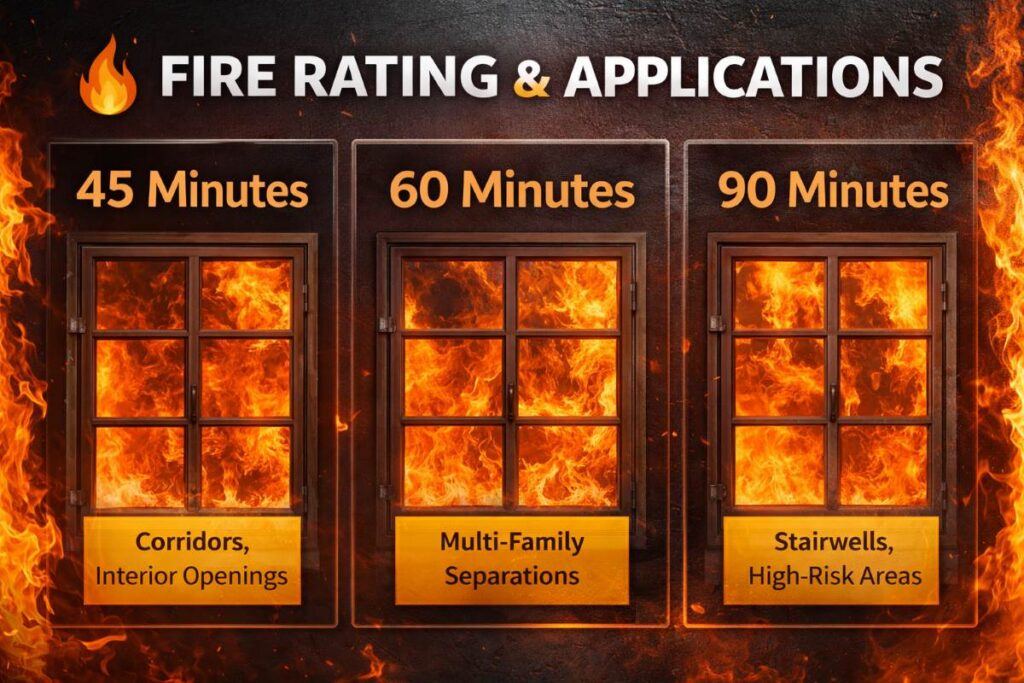
If a window carries a 90-minute rating, that means the entire assembly successfully withstood fire exposure for 90 minutes during testing.
Fire-Protective vs Fire-Resistive Systems
There are two categories:
| Type | Purpose |
|---|---|
| Fire-Protective | Blocks flames and smoke |
| Fire-Resistive | Limits heat transfer |
Most architectural fire-rated steel windows fall into non-temperature rise applications, meaning they prevent flame spread but may not fully block radiant heat unless paired with advanced glazing.
Understanding 45, 60 & 90 Minute Ratings
Not all fire ratings perform the same way.
What the Time Rating Actually Means
During testing, the window is exposed to temperatures reaching approximately 1600°F.
The assembly must:
- Maintain structural integrity
- Prevent flame passage
- Keep glazing secured
- Survive rapid cooling
It’s similar to taking a finished window and placing it inside a furnace.
Non-Temperature Rise Applications
Many systems are approved for non-temperature rise walls.
That means they:
- Stop flames
- Limit smoke spread
- Maintain frame stability
But they may not block radiant heat unless ceramic or advanced glazing is used.
How Ratings Affect Code Compliance
Building codes dictate where UL listed windows must be installed.
Typical locations include:
- Stair enclosures
- Property line openings
- School corridors
- Hospital partitions
- Commercial tenant separations
Without a certified rating, those openings fail inspection.
How Fire-Rated Windows Are Tested
Testing is intense and standardized.
ASTM E283 – Air Testing
Measures air infiltration under pressure.
This ensures smoke resistance.
ASTM E331 – Water Testing
Measures water penetration resistance.
Because a fire-rated window still needs to perform like a window.
ASTM E330 – Structural Testing
Measures resistance to uniform wind loads.
Fire-rated does not mean structurally weak.
The 1600°F Heat Test
The window is placed in a furnace.
Temperature ramps quickly.
Steel frames maintain shape.
Glass must remain intact.
Materials like vinyl and aluminum distort under these conditions.
Steel holds its profile.
The Hose Stream Test
After heat exposure, the window is blasted with high-pressure water.
Why?
Because real fires are extinguished with water.
The system must withstand sudden thermal shock without failure.
This is where inferior materials crack, warp, or collapse.
Steel systems maintain integrity.
Why Steel Is the Best Material for Fire Ratings
If fire protection matters, steel dominates.
Steel vs Aluminum Performance
| Material | Melting Point |
|---|---|
| Aluminum | ~1,220°F |
| Steel | ~2,500°F |
A fire can exceed aluminum’s melting point.
Steel remains structurally stable much longer.
Steel vs Wood Under Thermal Shock
Wood burns.
Vinyl melts.
Aluminum softens.
Steel retains form.
In a fire event, structural rigidity is everything.
Cold-Rolled vs Hot-Rolled Steel
| Type | Application |
|---|---|
| Cold-Rolled Steel | Thin sight lines, fire-rated assemblies |
| Hot-Rolled Steel | Solid sections, heavy-duty applications |
Cold-rolled galvanized steel offers precision profiles and high performance.
Hot-rolled steel offers solid mass and traditional aesthetics.
Both perform exceptionally in fire-rated systems.
Fire-Rated Glass Options Explained
The frame is only half the story.
Glazing determines performance level.
Wire Glass
Traditional option.
Embedded wire mesh.
45-minute ratings typical.
Pros:
- Cost-effective
- Code-approved
Limitations:
- Lower impact resistance
- Limited aesthetics
Ceramic Glass
Used for higher ratings.
Handles extreme temperatures without breaking.
Common in 90-minute applications.
Laminated Safety Ceramic
Adds impact resistance.
Improves sound performance.
Enhances safety in occupied buildings.
Insulated Fire-Rated Glass Units
Fire-rated glazing can be paired with insulated glass units (IGUs).
Benefits:
- Improved U-values
- Energy code compliance
- Better condensation resistance
Fire protection and energy performance can coexist.
Energy Performance in Fire-Rated Systems
Modern codes demand both fire and energy compliance.
U-Values & SHGC
Important metrics:
| Metric | What It Measures |
|---|---|
| U-Value | Heat transfer |
| SHGC | Solar heat gain |
| CR | Condensation resistance |
| VT | Visible light transmission |
Advanced fire-rated steel windows can meet demanding energy standards.
Meeting NYC Energy Code
Many systems meet or exceed NYC energy requirements when configured with insulated glazing.
That means:
- Lower heat loss
- Better occupant comfort
- Reduced condensation
Thermally Broken Steel Options
Thermally broken steel adds an insulating barrier between interior and exterior steel sections.
Think of it like cutting a thermal bridge in half.
This drastically improves performance without sacrificing strength.
Where Fire-Rated Windows Are Required
Fire-rated openings are not optional in many buildings.

Schools & Hospitals
Life safety first.
Corridor separation required.
Visibility must remain.
Commercial Buildings
Tenant separations.
Interior partitions.
Stairwell enclosures.
Multi-Family & High-Rise
Property line restrictions.
Rated shaft walls.
Fire barrier penetrations.
Historic Renovations
Steel windows allow preservation aesthetics while upgrading safety.
Narrow sight lines remain intact.
Code compliance improves dramatically.
Key Specifications to Look For
Not all systems are equal.
UL Listing & Certification
Look for:
- UL labeled assemblies
- Tested reports
- Code approvals
Without listing, the rating is meaningless.
Glazing Thickness Range
Many systems accommodate:
- 3/16″ up to 1″ glazing
- Insulated units
- Ceramic assemblies
Flexibility matters.
Frame Depth & Construction
Typical depths range:
| Series Type | Frame Depth |
|---|---|
| Fixed Systems | ~2 1/2″ |
| Operable Casement | ~2 1/8″ |
| Double Hung | ~4 1/4″ |
Fully welded construction is critical.
Finish & Corrosion Protection
High-performance systems include:
- Zinc enriched primer
- Powder coat finish
- Marine galvanizing options
Durability extends beyond fire protection.
Choosing the Right Fire-Rated Window System
Every project has different demands.
Fixed vs Operable
Fixed units offer maximum rating flexibility.
Operable units provide ventilation.
Both can be fire-rated when properly engineered.
Self-Closing Windows
Required in many corridor applications.
Spring-loaded hinges ensure closure.
Doors with Fire Ratings
Fire-rated doors integrate:
- Multi-point locking
- Welded frames
- Certified glazing
Custom Configurations
Steel allows:
- Large openings
- Slim sight lines
- Transoms and sidelites
- Custom muntin patterns
Design flexibility stays intact.
Why Fully Welded Steel Matters
A mechanically fastened frame can loosen over time.
A fully welded frame acts as one structural unit.
Structural Integrity
Welded joints resist:
- Heat distortion
- Wind loads
- Long-term fatigue
Long-Term Durability
Steel does not degrade like aluminum in high-heat conditions.
It maintains strength for decades.
Factory Glazed Systems
Pre-glazed units:
- Reduce site labor
- Ensure correct glazing installation
- Improve quality control
Consistency equals performance.
Final Thoughts on Fire-Rated Windows
Fire-rated windows are not decorative upgrades.
They are life safety systems.
They must:
- Pass extreme heat testing
- Survive hose stream impact
- Meet structural standards
- Comply with building codes
- Deliver energy efficiency
Steel remains the most reliable material for this application.
When engineered correctly, fire-rated windows combine safety, performance, and narrow sight line aesthetics without compromise.
And when safety is on the line, compromise is not an option.