

Positive pressure fire testing is one of the most critical standards in modern fire-rated window and door design.
When a fire breaks out, pressure changes inside a room can force flames and heat toward openings.
If a window system fails under that pressure, fire spreads fast.
That’s why understanding positive pressure fire conditions and UL 10C compliance is essential for architects, builders, and property owners.
What Is Positive Pressure in a Fire?
During a fire, heat develops rapidly at the source.
As temperatures rise, hot gases expand.
Pressure inside the room begins to build relative to the outside.
That pressure pushes against doors and windows.
This condition is called positive pressure.
Why Pressure Builds
- Heat rises toward the ceiling
- Expanding gases increase internal pressure
- Openings become stress points
- Flames seek the path of least resistance
Think of it like air inside a sealed metal drum placed over a flame.
As temperature increases, internal pressure rises and pushes outward.
In real buildings, windows and doors are that weak point if they are not properly tested.
What Is UL 10C?
UL 10C is a fire test standard developed by Underwriters Laboratories for positive pressure fire testing of door and window assemblies.
It simulates real-world fire conditions more accurately than older neutral pressure testing methods.
Key Elements of UL 10C Testing
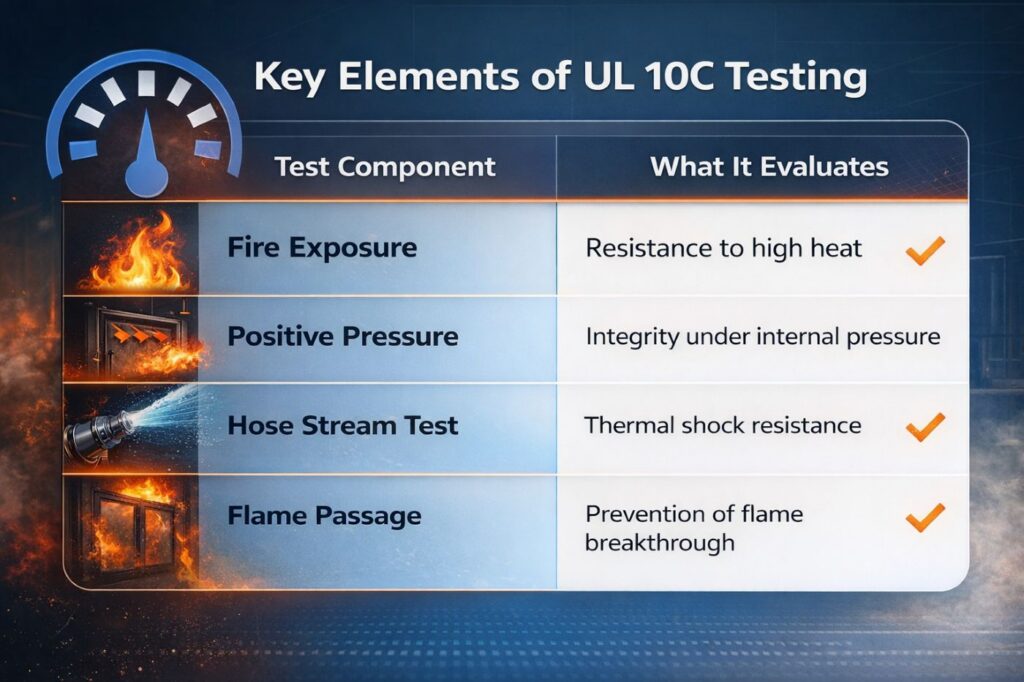
Unlike older standards, UL 10C introduces positive pressure during testing, which forces flames toward the assembly.
This creates a more demanding and realistic evaluation.
Why Positive Pressure Testing Is Critical
In early fire testing models, neutral pressure conditions were used.
Real fires are not neutral.
They generate internal pressure that actively pushes flames through openings.
If a window fails under positive pressure:
- Flames escape into adjacent rooms
- Smoke spreads rapidly
- Fire compartmentalization breaks down
- Evacuation time decreases
Positive pressure fire-rated windows are engineered to resist these forces.
How Fire-Rated Windows Respond to Positive Pressure
Modern fire-rated steel windows are built with:
- Fully welded frames
- Mechanically fastened glazing beads
- Fire-rated glass with tested assemblies
- Heavy-gauge steel construction
These components work together to:
- Maintain structural integrity
- Prevent flame passage
- Resist thermal shock
- Withstand internal pressure forces
Steel plays a major role.
When exposed to extreme heat, vinyl melts, aluminum softens, and wood ignites.
Steel maintains its form significantly longer.
The Role of Compartmentalization
Buildings are designed with fire compartments.
Each compartment slows fire spread long enough for evacuation and response.
Windows installed in:
- Stairwells
- Corridor walls
- Property line exposures
- Mixed-use separations
must maintain integrity under pressure.
Without positive pressure rated systems, fire can breach these barriers.
UL 10C vs. Older Fire Testing Standards
| Standard | Pressure Condition | Real-World Simulation |
|---|---|---|
| Neutral Pressure Testing | Minimal internal force | Less realistic |
| UL 10C Positive Pressure | Simulates pressure buildup | High realism |
UL 10C is widely recognized because it mirrors actual fire behavior more closely.
That added realism increases safety.
Hose Stream Test: The Second Challenge
After the furnace test, the assembly undergoes a hose stream test.
This step simulates:
- Sudden cooling from firefighting efforts
- Structural shock
- Impact force
If glass shatters or frames deform, the system fails.
Passing both the furnace test and hose stream test confirms durability under extreme transitions.
Applications That Require Positive Pressure Compliance
Commercial Buildings
- Hospitals
- Schools
- Office towers
- Hotels
Multi-Family Residential
- Urban developments
- Mixed-use properties
- High-rise stairwells
Exterior Property Line Installations
- Buildings close to lot lines
- Fire separation walls
In these environments, UL 10C compliant fire-rated windows are often mandatory.
Engineering Considerations in Positive Pressure Design
Designing for positive pressure requires attention to:
- Frame depth
- Glazing thickness
- Anchoring methods
- Reinforcement profiles
- Locking hardware integrity
Proper installation is equally important.
Even the strongest assembly can fail if improperly anchored.
Benefits of Positive Pressure Fire-Rated Windows
| Benefit | Impact |
|---|---|
| Improved Life Safety | Slows fire spread |
| Code Compliance | Meets UL 10C standards |
| Structural Integrity | Maintains compartment barriers |
| Reduced Liability | Verified third-party testing |
| Long-Term Durability | Steel withstands extreme conditions |
Positive pressure testing adds an extra layer of assurance.
It is not just about passing a test.
It is about performing when it matters most.
Fire Behavior and Pressure Dynamics Explained
When fire ignites:
- Heat rises rapidly.
- Upper layers of air expand.
- Pressure increases near the ceiling.
- Flames are pushed outward.
- Openings become exit points.
Without properly rated assemblies, flames can escape through glazing within minutes.
Positive pressure rated windows are engineered to resist that force.
Why Steel Is the Preferred Material
Steel provides:
- High melting point
- Structural rigidity
- Welded construction strength
- Long lifecycle durability
It behaves predictably under heat.
That predictability is crucial in fire design.
Common Misconceptions About Fire-Rated Windows
“All fire-rated windows are the same.”
False.
Only systems tested under positive pressure UL 10C conditions provide realistic fire resistance.
“Glass alone provides the rating.”
Incorrect.
The entire assembly must be tested as a system.
Frame, glazing, anchors, and hardware all matter.
“Neutral pressure testing is enough.”
Modern codes increasingly recognize positive pressure testing as more accurate.
Are Positive Pressure Fire-Rated Windows Worth It?
If your project includes:
- Occupant-heavy buildings
- Tight urban construction
- Multi-story layouts
- Code-mandated fire separations
Then yes.
The added protection of UL 10C positive pressure compliance provides measurable safety advantages.
Final Thoughts
Positive pressure fire testing reflects real fire behavior.
It evaluates how windows and doors perform when internal heat builds and pressure forces flames toward openings.
Systems tested to UL 10C standards are engineered to maintain integrity under those demanding conditions.
In high-performance building design, positive pressure compliance is not optional.
It is a critical component of modern fire safety strategy.